
Quick answer
For safer UK car journeys, use a suitable dog restraint, provide a secure non-slip space, maintain ventilation and keep water, a lead, towels and emergency information within easy reach. Fit and use the restraint correctly on every journey—not only long trips.
A dog-friendly road trip does not require a boot full of gadgets. The essentials are the items that reduce distraction, protect your dog during sudden braking and solve predictable problems such as thirst, mud, sickness and an urgent toilet stop.
In this guide
The UK restraint rule • restraint options compared • a complete packing checklist • preparing the car • safe journey breaks • warm-weather risks • Harley’s Lake District routine • FAQs
The UK rule on dogs travelling in cars
Rule 57 of the Highway Code says dogs and other animals should be suitably restrained so they cannot distract the driver or injure themselves or someone else if the vehicle stops quickly. It gives a seat-belt harness, pet carrier, dog cage or dog guard as examples.
A normal walking harness is not automatically a vehicle restraint. Check what the manufacturer says the product is designed for, follow its vehicle-fitting instructions and choose the correct size for your dog. If you are unsure which arrangement suits your car, seek product-specific professional advice.
Dog car restraints at a glance
| Option | May suit | Check carefully |
|---|---|---|
| Seat-belt travel harness | Dogs travelling on a passenger seat | Correct size, attachment point and vehicle compatibility |
| Secured carrier or crate | Dogs that relax in a defined space | Anchoring, ventilation, door security and room to settle |
| Dog guard | Suitable boot areas | Vehicle fit and whether further containment is required |
| Travel cage | Larger boots and regular travellers | Secure installation, access and safe dimensions |
🐾 Harley’s Hint
We keep Harley’s loading routine boringly consistent: lead on, car opened, same travelling area and the same calm cue. That predictability is much easier for him than everyone carrying bags while repeatedly opening different doors.
The complete dog car travel checklist
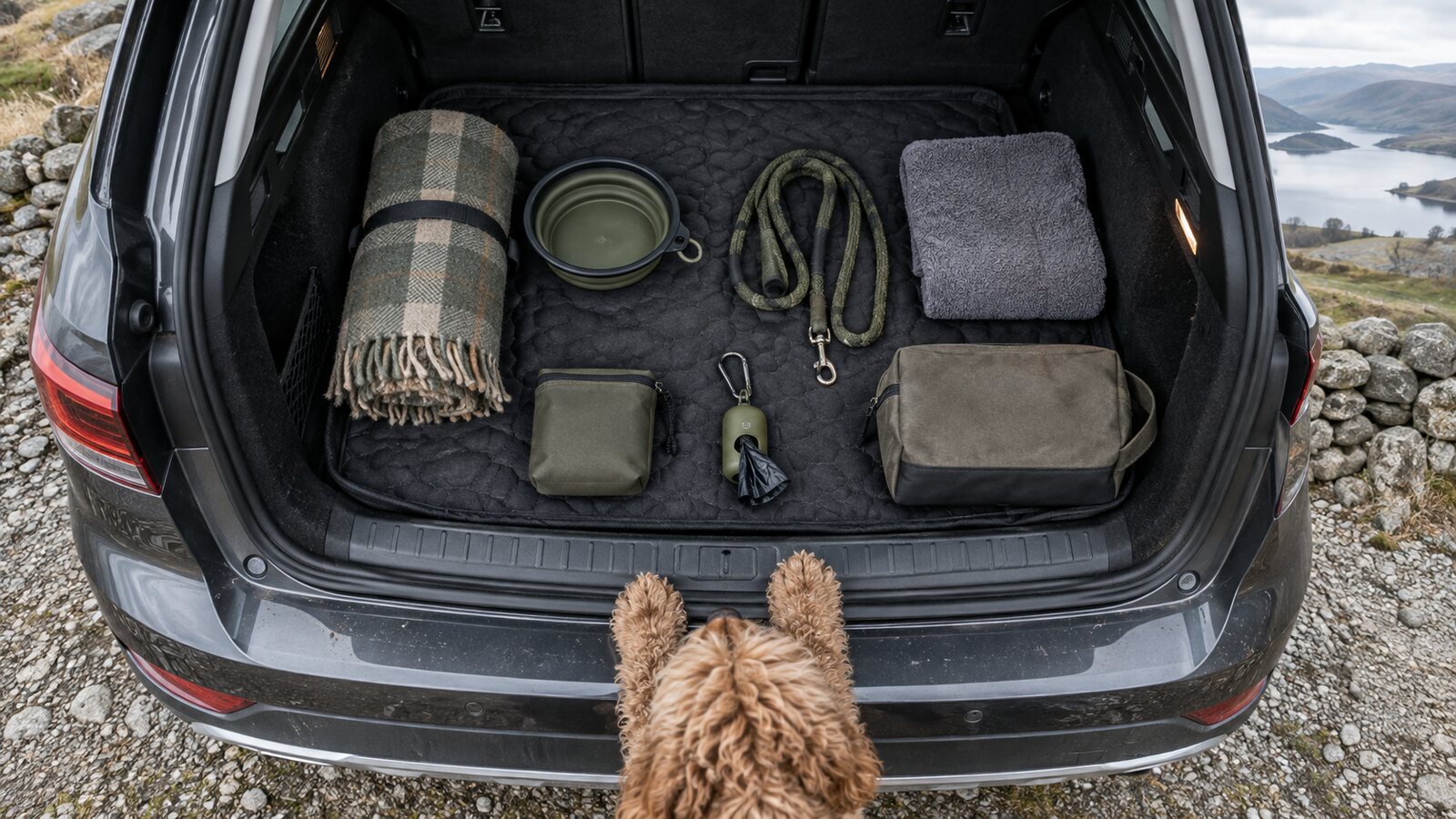
| Essential | Why it earns its place | Where to keep it |
|---|---|---|
| Suitable restraint | Reduces distraction and injury risk | Correctly fitted before departure |
| Water and bowl | Useful during breaks and after walks | Accessible travel bag |
| Lead and walking harness | Safer unloading in unfamiliar places | Attached before doors open |
| Non-slip bedding | Creates a more stable resting surface | Dog’s secured travel area |
| Towels and washable liner | Manage rain, mud and sickness | Boot or footwell |
| Poo bags and wipes | Handle routine stops and small messes | Door pocket or pouch |
| First-aid information | Supports a prompt emergency response | Clearly labelled and reachable |
1. Create a stable travelling space
Use suitable non-slip bedding so your dog is not sliding on every bend. Keep hard, sharp and heavy objects out of the dog’s area, and secure luggage so it cannot move during braking. Do not block airflow around a crate or boot space.
A familiar blanket may help some dogs settle, but it is not a restraint by itself. Check it regularly for chewing, overheating and dampness, particularly after swimming or a rainy walk.
2. Carry water and a travel bowl
Take clean water even when your route passes lakes and streams. A collapsible bowl is convenient because it stores flat; our dog bowl guide explains the differences between travel and everyday options.
Put water somewhere you can reach at the next safe stop without unloading the entire boot. Do not attempt to offer a loose bowl while the vehicle is moving.
3. Attach the lead before opening the car
At service stations, viewpoints and unfamiliar car parks, attach the lead before a door or boot is opened. Traffic, wildlife and new smells can change a normally reliable dog’s behaviour. Keep the walking lead accessible but stored so it cannot tangle around your dog in transit.
The Halti Control Lead (affiliate link) is one existing walking and unloading option. It is not presented here as a car restraint. You can also compare our dog lead picks for different walking situations.
4. Pack for rain, mud and sickness
A washable boot or seat liner reduces cleaning, while a towel lets you deal with wet paws before your dog settles. Carry a spare clean layer: making a dog sit on a cold saturated towel is neither comfortable nor helpful.
For small suitable clean-ups, we use Floofs Pet Wipes (affiliate link). Wipes do not replace rinsing heavy grit, cleaning a wound or bathing when necessary. See our muddy-dog cleaning routine for the fuller job.
5. Keep everyday supplies together
Poo bags, a spare roll, familiar treats and any regular medication belong in one travel pouch. The Tuff Pets poo bags we use (affiliate link) can remain attached to the walking lead or in the door pocket. Avoid introducing several rich treats during a long trip, especially if your dog is prone to nausea.
6. Add first-aid and emergency details
Save your vet, destination-area emergency vet and insurance details on your phone. A small kit can help protect a minor injury while you arrange professional advice, but it cannot replace veterinary care. Build yours with our dog first-aid kit checklist.
Prepare the car before loading your dog
- Exercise and toilet your dog before a longer journey.
- Fit and check the restraint while the car is stationary.
- Secure shopping, walking poles and luggage.
- Set a comfortable temperature and test ventilation.
- Put water, lead and emergency details within reach.
- Plan safe stopping points before joining remote roads.
- Check that identification and microchip contact details are current.
🐾 Harley’s Hint
Living in the Lake District means we judge journeys by the road, not just the mileage. A short stretch of narrow bends can be harder than a longer smooth drive, so we give Harley a calm toilet-and-sniff break before the twistiest section.
Plan safe breaks on longer journeys
The RSPCA recommends regular breaks on long journeys, with dogs exercised on a lead and protected from escaping as they leave the vehicle. Stop at a proper service area or car park—never a narrow verge or blind bend simply because your dog becomes restless.

During the break, offer water, allow a calm toilet walk and check for panting, drooling, repeated swallowing, vomiting or unusual distress. These signs may indicate anxiety, overheating or nausea. Our separate guide covers dog travel sickness and what may help.
Never leave a dog in a warm car
The RSPCA warns that cars can become dangerously hot even when the weather does not feel extreme or a window is open. Shade moves, ventilation is not enough and a “quick” stop can take longer than planned.
Travel at cooler times where possible and monitor your dog. Heavy panting, drooling, weakness, confusion or collapse can indicate heatstroke. Begin appropriate cooling and contact a vet urgently.
Common dog-travel mistakes
- Using a walking harness as a car restraint without checking its purpose.
- Packing water underneath all the luggage.
- Opening the boot before attaching the lead.
- Allowing shopping or equipment to slide beside the dog.
- Treating a blanket as sufficient restraint.
- Letting a dog put their head outside an open window.
- Saving the first long journey for the day of a holiday.
Frequently asked questions
Can a dog travel loose in the boot?
The Highway Code says dogs should be suitably restrained. A loose boot may not prevent distraction or injury during sudden braking. Choose an appropriate arrangement for your dog and vehicle.
How often should we stop?
There is no perfect interval for every dog. Age, health, weather, journey length and confidence matter. Plan regular safe opportunities for water and toileting, and stop sooner if your dog appears unwell.
What can stay in the car permanently?
A spare lead, poo bags, towel, bowl and basic kit are useful, but refresh stored water, check expiry dates and remove anything that extreme heat or cold could damage.
What if my dog hates travelling?
Build confidence through short stationary-car sessions and tiny pleasant journeys. Do not simply force repeated long trips. Speak to your vet if your dog drools, vomits, panics or suddenly develops a problem.
The practical bottom line
Start with a suitable restraint and stable travelling space. Then add the items that solve real problems: water, a ready lead, towels, poo bags and emergency information. A calm routine used on every short journey is better preparation than buying equipment the night before a holiday.
This article contains affiliate links. If you buy through one, Harley Barley & Co may earn a commission at no extra cost to you.