
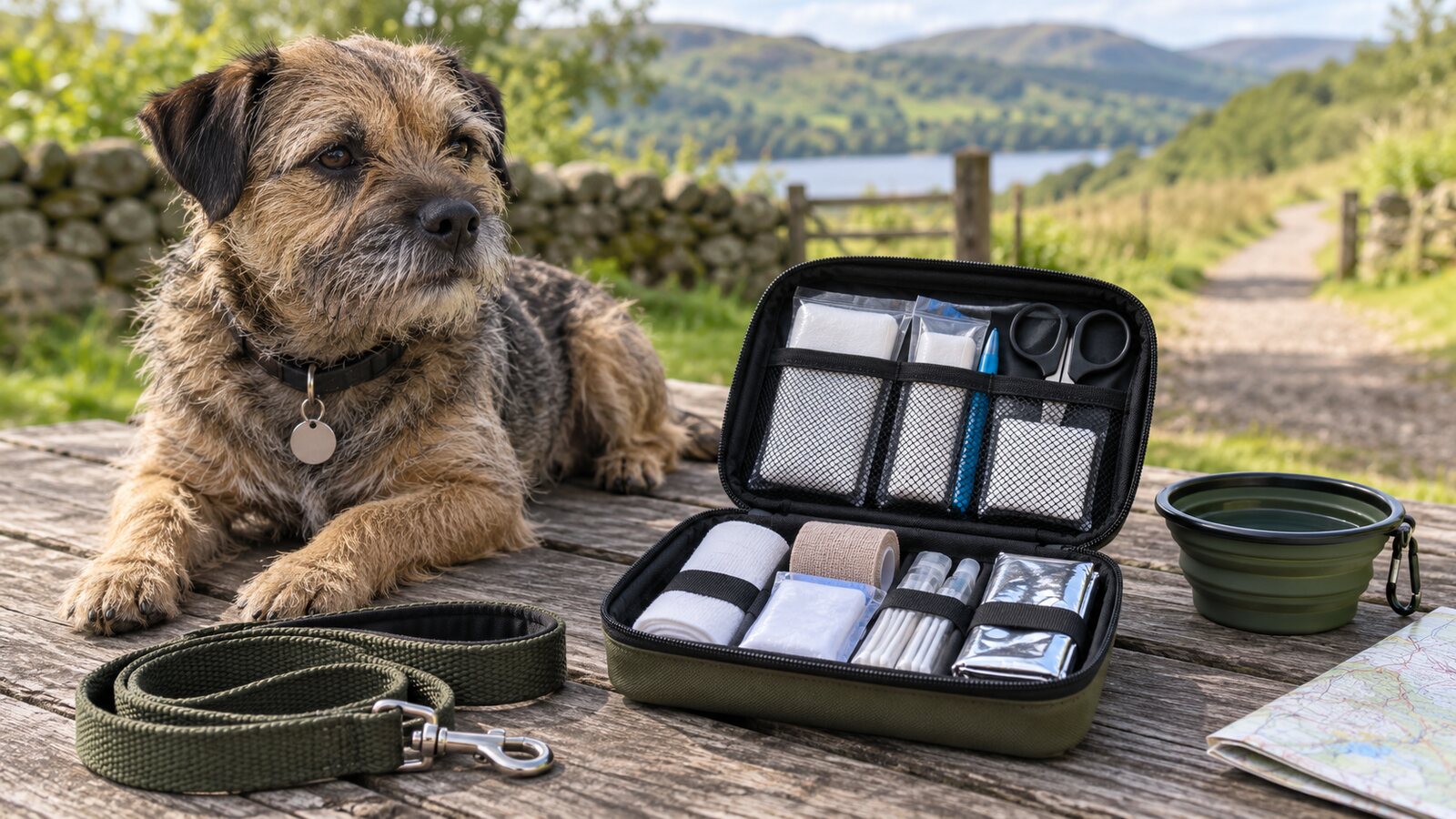
We carry a compact kit when walking Harley in the Lake District, especially on longer or quieter routes. The goal is not to practise veterinary medicine outdoors; it is to protect him safely while contacting professional help.
In this guide
- The complete kit list
- What each item is for
- Emergency warning signs
- Paw, tick and wound basics
- How to store and maintain the kit
A compact first-aid kit cannot replace a vet, but it can help you protect a wound, remove a visible loose thorn or keep your dog comfortable while arranging proper care.
Save these details first
Store your vet’s number, the nearest emergency practice and your pet-insurance contact in your phone. In a serious incident, call the vet before improvising treatment.
A useful walking kit
- Sterile non-stick dressings and gauze.
- A conforming bandage and cohesive outer wrap.
- Saline pods for gently flushing eyes or wounds.
- Blunt-ended scissors and tweezers.
- Disposable gloves.
- A clean towel or foil blanket.
- Tick-removal tool.
- Your dog’s medication and essential medical information.
Important limits
Never wrap a bandage tightly, remove an embedded object or give human painkillers. Do not apply antiseptics, creams or essential oils unless a veterinary professional says they are suitable.
If your dog is bleeding
Keep everyone safe, because pain can make even a gentle dog react. Apply steady pressure with a clean dressing and call a vet. Heavy bleeding, breathing difficulty, collapse, seizures or suspected heatstroke are emergencies.
If something is in a paw
A loose, superficial thorn may be removable with clean tweezers. Stop if it is deep, painful or difficult to grasp. Rinse dirt away, protect the area and seek veterinary advice.
Make the kit usable
Check expiry dates, replace used items and keep the kit somewhere instantly reachable rather than underneath the picnic. A short canine first-aid course is more valuable than owning equipment you have never practised using.
The PDSA pet first-aid guide is a useful reference. Add the kit to our dog walking essentials checklist for longer outings.
What each item is actually for
| Item | Useful for | Important limit |
|---|---|---|
| Sterile dressing | Covering a wound | Does not replace veterinary assessment |
| Saline pod | Gentle flushing | Do not force into an injured eye |
| Cohesive wrap | Holding padding in place | Can restrict circulation if tight |
| Tick tool | Correct tick removal | Use the tool instructions |
| Foil blanket | Reducing heat loss | Avoid overheating |
| Tweezers | Loose superficial debris | Never dig for embedded objects |
🐾 Harley’s Hint
Our walking kit for Harley is deliberately small enough that we will actually take it. A perfect kit left at home is less useful than a basic, checked kit in the rucksack.
Know the urgent warning signs
- Difficulty breathing or blue, grey or very pale gums
- Collapse, severe weakness or seizures
- Heavy or uncontrolled bleeding
- Suspected poisoning
- Severe heatstroke signs
- A swollen abdomen with repeated unproductive retching
- Major trauma, deep wounds or suspected fractures
Call a vet immediately in these situations. If phone signal is unreliable, know the nearest road access and tell someone your planned route.
Ticks, paws and minor wounds
Use a purpose-made tick tool and follow its instructions, removing the whole tick without squeezing the body. For a minor superficial paw injury, gently rinse visible dirt and protect the area for the journey home. Embedded glass, deep thorns and painful wounds need a vet.
Bandaging caution
An improvised bandage can become dangerously tight as swelling develops. Use only enough pressure to control bleeding, keep checking toes and circulation, and follow veterinary instructions by phone.
Maintain the kit
- Check it at the start of each season.
- Replace opened or expired sterile items.
- Keep contents dry in a clearly labelled pouch.
- Add a card with medications, allergies and emergency contacts.
- Practise finding each item without emptying the whole bag.
🐾 Harley’s Hint
We keep Harley’s kit beside his lead between trips. That makes checking and repacking it part of the walking routine rather than a separate job we are likely to forget.
Preparing before remote walks
Download the route, check phone coverage and weather, and tell someone where you are going. Save the nearest veterinary practice. A map reference can help rescuers reach you, but it does not replace navigation skills.
Moving an injured dog
Pain can cause fear and biting. Approach calmly, avoid unnecessary movement and call a vet. A towel may help support a small dog, but suspected spinal or major limb injuries need professional instruction.
Suspected poisoning
Remove access to the substance, keep packaging or take a photograph and telephone a vet immediately. Do not make your dog vomit or give food, salt, milk or charcoal unless instructed.
Heatstroke
Move the dog into shade, begin cooling with cool—not ice-cold—water, create airflow and contact a vet urgently. Do not cover the dog with wet towels because they can trap heat.
Frequently asked questions
Can I give human painkillers?
No. Human painkillers can be toxic to dogs. Only give medication prescribed specifically for that dog and situation.
Should I include antiseptic cream?
Only include products your vet recommends. Some ingredients are unsafe if licked, and using the wrong substance can delay treatment.
Is a ready-made kit enough?
It is a starting point. Add your dog’s medical details, medication and emergency contacts. Training and a charged phone remain essential.