
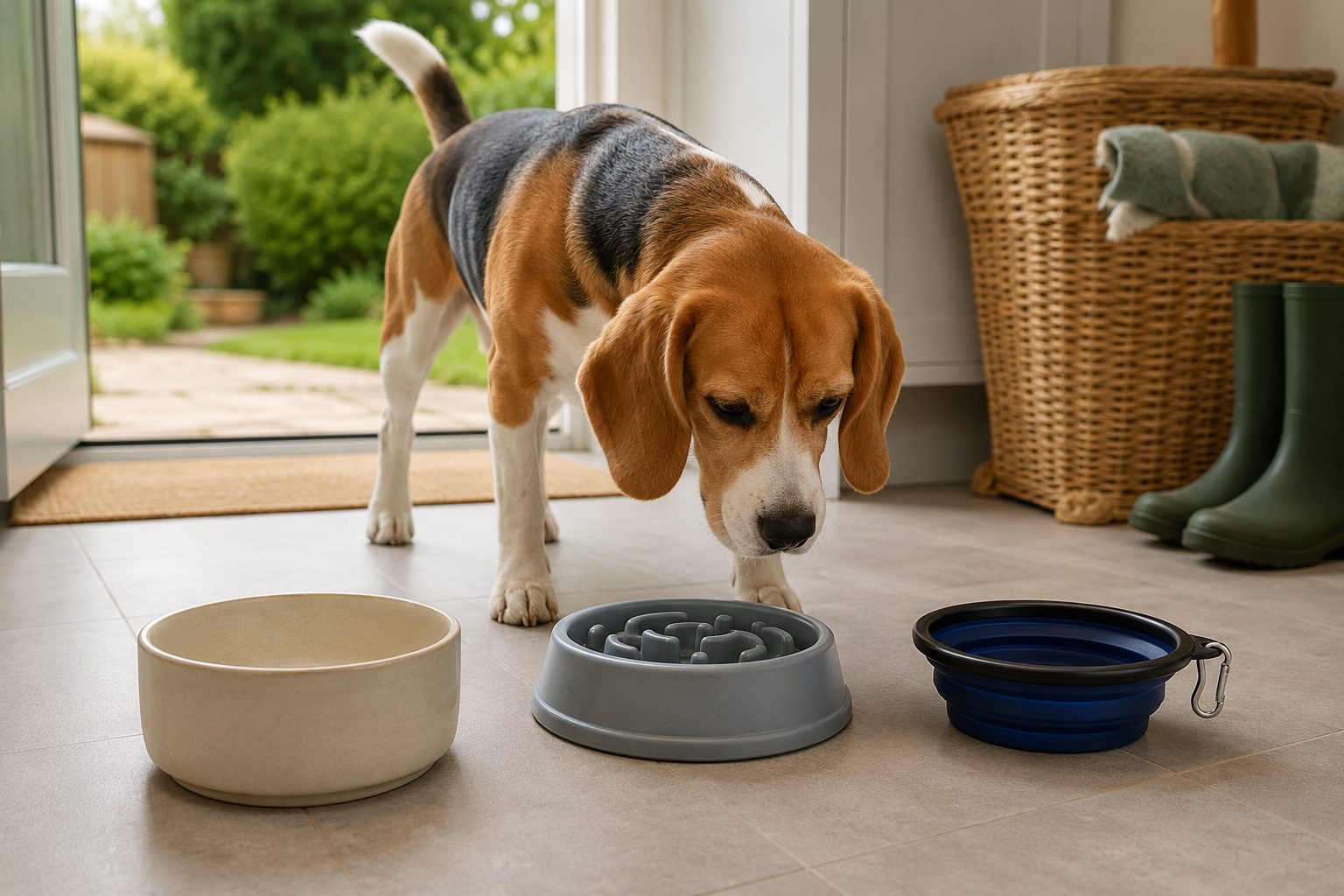
🛍️ Shopping tip: The “best” dog bowl really depends on the job. For everyday feeding, prioritise stability and easy cleaning; for fast eaters, try a slow feeder; and for days out, a lightweight travel bowl earns its place in the bag. Setting up for a new dog? Our new puppy checklist covers the rest of the essentials, while Harley’s real feeding experience is in our Pure Pet Food review.
Harley Barley • Buying Guides
Everyday bowls, slower dinners and easier adventures
The humble dog bowl becomes surprisingly complicated once you add fast eating, long ears, travel, messy fresh food and a dog who considers dinner an emergency. Our best everyday pick is the Beco Dog Bowl, while the MateeyLife slow feeder is the more relevant choice for dogs who inhale meals.
This article contains affiliate links. We may receive a small commission if you buy through one, at no extra cost to you. These are researched options; we do not claim Harley has personally tested every bowl.
Our quick picks
| Best for | Bowl | Why we picked it | Link |
|---|---|---|---|
| Best everyday bowl | Beco Dog Bowl | Simple all-purpose feeding option | Check on Amazon UK |
| Best classic slow feeder | MateeyLife | Puzzle channels designed to slow access to food | Check on Amazon UK |
| Best raised option | Toozey Raised Dog Bowl | Elevates the feeding position | Check on Amazon UK |
| Best for travel | OHMO Collapsible Water Bowl | Packs down for walks and trips | Check on Amazon UK |
| Best bowl-and-lick-mat style | Lesipee Slow Feeder | Adds licking and enrichment to mealtimes | Check on Amazon UK |
What should I look for in a dog bowl?
The best dog bowl is stable, easy to clean, correctly sized and appropriate for what you feed. Before getting distracted by colours, check:
- Whether it is dishwasher-safe or easy to hand-wash
- Whether the base slides across your floor
- Whether your dog can reach the food comfortably
- Whether scratches or damage will be easy to spot
- Whether the shape suits long ears, a broad muzzle or a short nose
- Whether it works with wet, dry, rehydrated or raw food as intended
Wash food bowls after meals and refresh water daily. Outdoor water bowls should also be protected from slugs and snails, which can be involved in transmitting lungworm.
1. Beco Dog Bowl — best everyday choice
View the Beco Dog Bowl on Amazon UK
The Beco is our straightforward everyday pick. It is the bowl to consider when you want something practical for regular meals without turning feeding time into an obstacle course.
Good for: Everyday food or water, depending on the current product specifications.
Honest drawback: A standard bowl does not slow a dog who eats too quickly.
Who it suits: Calm eaters and owners prioritising simplicity.
2. MateeyLife Slow Feeder — best for fast eaters
View the MateeyLife slow feeder on Amazon UK
The raised channels in a slow feeder make food less accessible in one enormous mouthful. This can extend mealtime and add a small amount of problem-solving.
Good for: Dogs who finish meals at startling speed.
Honest drawback: Intricate channels take more effort to clean, particularly with wet or rehydrated food.
Who it suits: Dogs who engage calmly with food puzzles rather than chewing the bowl.
Watch first use: Choose a size and pattern that lets your dog reach the food comfortably. Stop if they become distressed, chew the material or scrape their face.
3. Toozey Raised Dog Bowl — best raised option
View the Toozey Raised Dog Bowl on Amazon UK
A raised station can reduce how far a dog needs to bend and may make the feeding area tidier. It is not automatically healthier for every dog, and claims that raised bowls prevent digestive emergencies should be treated cautiously.
Good for: Dogs who appear more comfortable eating from a modest height, subject to veterinary advice.
Honest drawback: The wrong height can create an awkward posture, and raised feeding is not universally recommended.
Who it suits: Owners with a specific comfort or accessibility reason, not simply because elevation looks smart.
Ask your vet before switching if your dog has swallowing problems, mobility issues or a breed-related risk of gastric dilatation-volvulus (bloat).
4. OHMO Collapsible Water Bowl — best for travel
View the OHMO collapsible bowl on Amazon UK
A collapsible bowl earns its place by being easy to carry. Clip it to a walking bag, keep one in the car and offer water on longer outings rather than relying on puddles or communal bowls.
Good for: Walks, holidays, café stops and car journeys.
Honest drawback: Lightweight bowls can tip or fold if a very enthusiastic dog stands on the edge.
Who it suits: Anyone whose dog regularly joins them away from home.
5. Lesipee Slow Feeder and Lick Mat — best enrichment option
View the Lesipee slow feeder and lick mat on Amazon UK
This style spreads food across a textured surface, turning the meal into a licking activity. Rehydrated food such as Pure Pet Food can work particularly well on lick-friendly surfaces, provided you still serve the dog’s measured portion.
Good for: Extending mealtime and adding calm enrichment.
Honest drawback: Textured surfaces need thorough cleaning, and determined chewers require supervision.
Who it suits: Dogs who enjoy licking and owners happy to wash the grooves properly.
Are slow-feeder bowls good for dogs?
They can be useful for dogs who gulp meals, but they should slow eating without making it frustrating or physically difficult. Begin with an easier pattern and observe your dog.
Slow feeders do not fix every cause of frantic eating. If your dog’s appetite has suddenly increased, they lose weight, vomit repeatedly or seem unwell, speak to your vet.
Are raised dog bowls better?
Not as a blanket rule. A raised bowl may improve comfort for an individual dog, but height should suit their body and any medical claims should be discussed with a vet. Avoid presenting elevation as a universal solution.
For most healthy dogs, a stable bowl at floor level remains a perfectly reasonable starting point.
What bowl is best for Pure Pet Food?
Pure is mixed with warm water, so choose a bowl that is easy to scrub after a moist meal. A standard Beco bowl keeps things simple, while the Lesipee lick-mat style can extend the meal for dogs who enjoy licking.
Whichever you use, measure the same planned portion. A slow feeder changes the pace, not the amount your dog needs.
How often should I wash my dog’s bowl?
Wash a food bowl after each wet or rehydrated meal and regularly after dry food. Empty, clean and refill the water bowl daily—or more often if it collects food, hair or outdoor debris.
Inspect bowls for cracks, sharp edges and deep scratches where grime can collect. Follow the manufacturer’s cleaning instructions, particularly for collapsible or textured products.
Try this: Keep two everyday bowls in rotation. One can be properly washed and dried while the other is in use, removing the temptation to give yesterday’s bowl a hopeful rinse.
Frequently asked questions
What size dog bowl should I buy?
It should h
Harley Barley • Buying Guides
Everyday bowls, slower dinners and easier adventures
The humble dog bowl becomes surprisingly complicated once you add fast eating, long ears, travel, messy fresh food and a dog who considers dinner an emergency. Our best everyday pick is the Beco Dog Bowl, while the MateeyLife slow feeder is the more relevant choice for dogs who inhale meals.
This article contains affiliate links. We may receive a small commission if you buy through one, at no extra cost to you. These are researched options; we do not claim Harley has personally tested every bowl.
Our quick picks
| Best for | Bowl | Why we picked it | Link |
|---|---|---|---|
| Best everyday bowl | Beco Dog Bowl | Simple all-purpose feeding option | Check on Amazon UK |
| Best classic slow feeder | MateeyLife | Puzzle channels designed to slow access to food | Check on Amazon UK |
| Best raised option | Toozey Raised Dog Bowl | Elevates the feeding position | Check on Amazon UK |
| Best for travel | OHMO Collapsible Water Bowl | Packs down for walks and trips | Check on Amazon UK |
| Best bowl-and-lick-mat style | Lesipee Slow Feeder | Adds licking and enrichment to mealtimes | Check on Amazon UK |
What should I look for in a dog bowl?
The best dog bowl is stable, easy to clean, correctly sized and appropriate for what you feed. Before getting distracted by colours, check:
- Whether it is dishwasher-safe or easy to hand-wash
- Whether the base slides across your floor
- Whether your dog can reach the food comfortably
- Whether scratches or damage will be easy to spot
- Whether the shape suits long ears, a broad muzzle or a short nose
- Whether it works with wet, dry, rehydrated or raw food as intended
Wash food bowls after meals and refresh water daily. Outdoor water bowls should also be protected from slugs and snails, which can be involved in transmitting lungworm.
1. Beco Dog Bowl — best everyday choice
View the Beco Dog Bowl on Amazon UK
The Beco is our straightforward everyday pick. It is the bowl to consider when you want something practical for regular meals without turning feeding time into an obstacle course.
Good for: Everyday food or water, depending on the current product specifications.
Honest drawback: A standard bowl does not slow a dog who eats too quickly.
Who it suits: Calm eaters and owners prioritising simplicity.
2. MateeyLife Slow Feeder — best for fast eaters
View the MateeyLife slow feeder on Amazon UK
The raised channels in a slow feeder make food less accessible in one enormous mouthful. This can extend mealtime and add a small amount of problem-solving.
Good for: Dogs who finish meals at startling speed.
Honest drawback: Intricate channels take more effort to clean, particularly with wet or rehydrated food.
Who it suits: Dogs who engage calmly with food puzzles rather than chewing the bowl.
Watch first use: Choose a size and pattern that lets your dog reach the food comfortably. Stop if they become distressed, chew the material or scrape their face.
3. Toozey Raised Dog Bowl — best raised option
View the Toozey Raised Dog Bowl on Amazon UK
A raised station can reduce how far a dog needs to bend and may make the feeding area tidier. It is not automatically healthier for every dog, and claims that raised bowls prevent digestive emergencies should be treated cautiously.
Good for: Dogs who appear more comfortable eating from a modest height, subject to veterinary advice.
Honest drawback: The wrong height can create an awkward posture, and raised feeding is not universally recommended.
Who it suits: Owners with a specific comfort or accessibility reason, not simply because elevation looks smart.
Ask your vet before switching if your dog has swallowing problems, mobility issues or a breed-related risk of gastric dilatation-volvulus (bloat).
4. OHMO Collapsible Water Bowl — best for travel
View the OHMO collapsible bowl on Amazon UK
A collapsible bowl earns its place by being easy to carry. Clip it to a walking bag, keep one in the car and offer water on longer outings rather than relying on puddles or communal bowls.
Good for: Walks, holidays, café stops and car journeys.
Honest drawback: Lightweight bowls can tip or fold if a very enthusiastic dog stands on the edge.
Who it suits: Anyone whose dog regularly joins them away from home.
5. Lesipee Slow Feeder and Lick Mat — best enrichment option
View the Lesipee slow feeder and lick mat on Amazon UK
This style spreads food across a textured surface, turning the meal into a licking activity. Rehydrated food such as Pure Pet Food can work particularly well on lick-friendly surfaces, provided you still serve the dog’s measured portion.
Good for: Extending mealtime and adding calm enrichment.
Honest drawback: Textured surfaces need thorough cleaning, and determined chewers require supervision.
Who it suits: Dogs who enjoy licking and owners happy to wash the grooves properly.
Are slow-feeder bowls good for dogs?
They can be useful for dogs who gulp meals, but they should slow eating without making it frustrating or physically difficult. Begin with an easier pattern and observe your dog.
Slow feeders do not fix every cause of frantic eating. If your dog’s appetite has suddenly increased, they lose weight, vomit repeatedly or seem unwell, speak to your vet.
Are raised dog bowls better?
Not as a blanket rule. A raised bowl may improve comfort for an individual dog, but height should suit their body and any medical claims should be discussed with a vet. Avoid presenting elevation as a universal solution.
For most healthy dogs, a stable bowl at floor level remains a perfectly reasonable starting point.
What bowl is best for Pure Pet Food?
Pure is mixed with warm water, so choose a bowl that is easy to scrub after a moist meal. A standard Beco bowl keeps things simple, while the Lesipee lick-mat style can extend the meal for dogs who enjoy licking.
Whichever you use, measure the same planned portion. A slow feeder changes the pace, not the amount your dog needs.
How often should I wash my dog’s bowl?
Wash a food bowl after each wet or rehydrated meal and regularly after dry food. Empty, clean and refill the water bowl daily—or more often if it collects food, hair or outdoor debris.
Inspect bowls for cracks, sharp edges and deep scratches where grime can collect. Follow the manufacturer’s cleaning instructions, particularly for collapsible or textured products.
Try this: Keep two everyday bowls in rotation. One can be properly washed and dried while the other is in use, removing the temptation to give yesterday’s bowl a hopeful rinse.
Frequently asked questions
What size dog bowl should I buy?
It should hold the full meal or enough water without being so deep that your dog struggles to reach the bottom. Check the listed capacity, not just small, medium or large labels.
Are tilted bowls better for dogs?
Some individual dogs may find an angled bowl comfortable, but there is no need to switch a healthy dog who eats normally. Ask your vet about posture or swallowing concerns.
Can dogs share a water bowl?
Dogs in the same household may share, but provide enough clean water and space to prevent guarding. Avoid communal outdoor bowls where hygiene is uncertain.
Why does my dog tip the bowl over?
They may paw from excitement, dislike the noise, play with water or find the bowl too light. Try a heavier non-slip design and keep the feeding area calm.
Our verdict
Choose the Beco Dog Bowl for uncomplicated daily use, the MateeyLife slow feeder for a fast eater and the OHMO collapsible bowl for the walking bag.
If you are deciding what goes in the bowl, read our honest Pure Pet Food review next.
Harley Barley • Buying Guides
Everyday bowls, slower dinners and easier adventures
The humble dog bowl becomes surprisingly complicated once you add fast eating, long ears, travel, messy fresh food and a dog who considers dinner an emergency. Our best everyday pick is the Beco Dog Bowl, while the MateeyLife slow feeder is the more relevant choice for dogs who inhale meals.
This article contains affiliate links. We may receive a small commission if you buy through one, at no extra cost to you. These are researched options; we do not claim Harley has personally tested every bowl.
Our quick picks
| Best for | Bowl | Why we picked it | Link |
|---|---|---|---|
| Best everyday bowl | Beco Dog Bowl | Simple all-purpose feeding option | Check on Amazon UK |
| Best classic slow feeder | MateeyLife | Puzzle channels designed to slow access to food | Check on Amazon UK |
| Best raised option | Toozey Raised Dog Bowl | Elevates the feeding position | Check on Amazon UK |
| Best for travel | OHMO Collapsible Water Bowl | Packs down for walks and trips | Check on Amazon UK |
| Best bowl-and-lick-mat style | Lesipee Slow Feeder | Adds licking and enrichment to mealtimes | Check on Amazon UK |
What should I look for in a dog bowl?
The best dog bowl is stable, easy to clean, correctly sized and appropriate for what you feed. Before getting distracted by colours, check:
- Whether it is dishwasher-safe or easy to hand-wash
- Whether the base slides across your floor
- Whether your dog can reach the food comfortably
- Whether scratches or damage will be easy to spot
- Whether the shape suits long ears, a broad muzzle or a short nose
- Whether it works with wet, dry, rehydrated or raw food as intended
Wash food bowls after meals and refresh water daily. Outdoor water bowls should also be protected from slugs and snails, which can be involved in transmitting lungworm.
1. Beco Dog Bowl — best everyday choice
View the Beco Dog Bowl on Amazon UK
The Beco is our straightforward everyday pick. It is the bowl to consider when you want something practical for regular meals without turning feeding time into an obstacle course.
Good for: Everyday food or water, depending on the current product specifications.
Honest drawback: A standard bowl does not slow a dog who eats too quickly.
Who it suits: Calm eaters and owners prioritising simplicity.
2. MateeyLife Slow Feeder — best for fast eaters
View the MateeyLife slow feeder on Amazon UK
The raised channels in a slow feeder make food less accessible in one enormous mouthful. This can extend mealtime and add a small amount of problem-solving.
Good for: Dogs who finish meals at startling speed.
Honest drawback: Intricate channels take more effort to clean, particularly with wet or rehydrated food.
Who it suits: Dogs who engage calmly with food puzzles rather than chewing the bowl.
Watch first use: Choose a size and pattern that lets your dog reach the food comfortably. Stop if they become distressed, chew the material or scrape their face.
3. Toozey Raised Dog Bowl — best raised option
View the Toozey Raised Dog Bowl on Amazon UK
A raised station can reduce how far a dog needs to bend and may make the feeding area tidier. It is not automatically healthier for every dog, and claims that raised bowls prevent digestive emergencies should be treated cautiously.
Good for: Dogs who appear more comfortable eating from a modest height, subject to veterinary advice.
Honest drawback: The wrong height can create an awkward posture, and raised feeding is not universally recommended.
Who it suits: Owners with a specific comfort or accessibility reason, not simply because elevation looks smart.
Ask your vet before switching if your dog has swallowing problems, mobility issues or a breed-related risk of gastric dilatation-volvulus (bloat).
4. OHMO Collapsible Water Bowl — best for travel
View the OHMO collapsible bowl on Amazon UK
A collapsible bowl earns its place by being easy to carry. Clip it to a walking bag, keep one in the car and offer water on longer outings rather than relying on puddles or communal bowls.
Good for: Walks, holidays, café stops and car journeys.
Honest drawback: Lightweight bowls can tip or fold if a very enthusiastic dog stands on the edge.
Who it suits: Anyone whose dog regularly joins them away from home.
5. Lesipee Slow Feeder and Lick Mat — best enrichment option
View the Lesipee slow feeder and lick mat on Amazon UK
This style spreads food across a textured surface, turning the meal into a licking activity. Rehydrated food such as Pure Pet Food can work particularly well on lick-friendly surfaces, provided you still serve the dog’s measured portion.
Good for: Extending mealtime and adding calm enrichment.
Honest drawback: Textured surfaces need thorough cleaning, and determined chewers require supervision.
Who it suits: Dogs who enjoy licking and owners happy to wash the grooves properly.
Are slow-feeder bowls good for dogs?
They can be useful for dogs who gulp meals, but they should slow eating without making it frustrating or physically difficult. Begin with an easier pattern and observe your dog.
Slow feeders do not fix every cause of frantic eating. If your dog’s appetite has suddenly increased, they lose weight, vomit repeatedly or seem unwell, speak to your vet.
Are raised dog bowls better?
Not as a blanket rule. A raised bowl may improve comfort for an individual dog, but height should suit their body and any medical claims should be discussed with a vet. Avoid presenting elevation as a universal solution.
For most healthy dogs, a stable bowl at floor level remains a perfectly reasonable starting point.
What bowl is best for Pure Pet Food?
Pure is mixed with warm water, so choose a bowl that is easy to scrub after a moist meal. A standard Beco bowl keeps things simple, while the Lesipee lick-mat style can extend the meal for dogs who enjoy licking.
Whichever you use, measure the same planned portion. A slow feeder changes the pace, not the amount your dog needs.
How often should I wash my dog’s bowl?
Wash a food bowl after each wet or rehydrated meal and regularly after dry food. Empty, clean and refill the water bowl daily—or more often if it collects food, hair or outdoor debris.
Inspect bowls for cracks, sharp edges and deep scratches where grime can collect. Follow the manufacturer’s cleaning instructions, particularly for collapsible or textured products.
Try this: Keep two everyday bowls in rotation. One can be properly washed and dried while the other is in use, removing the temptation to give yesterday’s bowl a hopeful rinse.
Frequently asked questions
What size dog bowl should I buy?
It should hold the full meal or enough water without being so deep that your dog struggles to reach the bottom. Check the listed capacity, not just small, medium or large labels.
Are tilted bowls better for dogs?
Some individual dogs may find an angled bowl comfortable, but there is no need to switch a healthy dog who eats normally. Ask your vet about posture or swallowing concerns.
Can dogs share a water bowl?
Dogs in the same household may share, but provide enough clean water and space to prevent guarding. Avoid communal outdoor bowls where hygiene is uncertain.
Why does my dog tip the bowl over?
They may paw from excitement, dislike the noise, play with water or find the bowl too light. Try a heavier non-slip design and keep the feeding area calm.
Our verdict
Choose the Beco Dog Bowl for uncomplicated daily use, the MateeyLife slow feeder for a fast eater and the OHMO collapsible bowl for the walking bag.
If you are deciding what goes in the bowl, read our honest Pure Pet Food review next.