
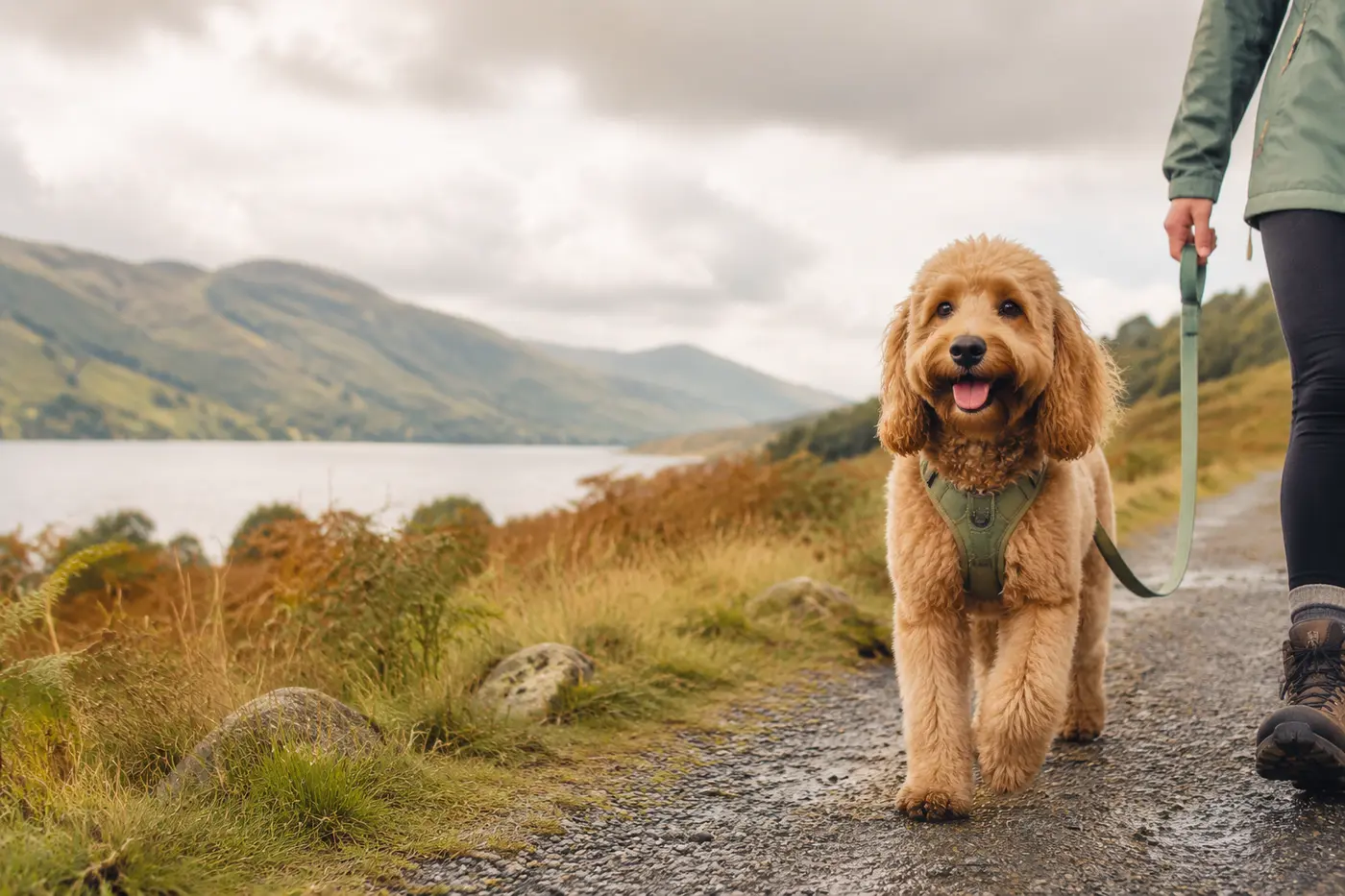
The guide at a glance
| Topic | Key point |
|---|---|
| Why are Cockapoos so excitable on walks? | Harley can walk beautifully when the world is quiet, then completely forget himself when another dog, an irresistible smell or something exciting appears. |
| Why do Cockapoos pull so much? | Cockapoos are typically bright, social and curious. |
| 1. Start somewhere almost painfully boring | Begin in the house, garden or a quiet stretch of pavement. |
| 2. Make the loose lead open doors | When the lead tightens, calmly stop. |
🐾 Cockapoo Life • Harley’s Experience
Why are Cockapoos so excitable on walks?
Harley can walk beautifully when the world is quiet, then completely forget himself when another dog, an irresistible smell or something exciting appears. This is the Cockapoo-specific side of walking calmly: why their bright, social, busy nature can make walks feel intense, and what has helped us make Harley’s walks easier.

Quick answer: Cockapoos often pull because moving forward is rewarding, the outside world is wildly exciting and nobody has yet shown them that a loose lead is what makes the adventure continue. Stop rewarding the pulling, generously reward the slack lead and practise somewhere boring before expecting success somewhere busy.
Harley can be wonderfully polite when nothing much is happening. Add another dog, an interesting smell or—heaven forbid—a squirrel, and suddenly the lead appears to be the only thing preventing him from joining the Formula One grid.
Why do Cockapoos pull so much?
Cockapoos are typically bright, social and curious. They notice people, dogs, smells, birds, discarded sandwich crumbs and suspicious-looking leaves. Their walking pace is naturally quicker than ours too, so pottering neatly beside a human does not come pre-installed.
- Excitement: the walk itself is a huge reward.
- Practice: every successful lunge towards a smell strengthens the habit.
- Distractions: the environment is more interesting than you are—temporarily, at least.
- Frustration: they can see where they want to go but cannot reach it.
- Equipment or discomfort: a poor fit can make walking awkward.
Loose-lead walking is a skill, and skills need teaching. A dog who behaves beautifully in the kitchen may genuinely struggle to remember any of it outside the front door.
⚠️ Before you assume it is “just pulling”
A sudden change in walking style, reluctance to move, limping, coughing, repeated scratching at the harness or sensitivity around the neck and shoulders deserves attention. Check the fit of the equipment and speak to your vet if you are worried about pain or breathing.
How do you teach a Cockapoo to walk on a loose lead?
1. Start somewhere almost painfully boring
Begin in the house, garden or a quiet stretch of pavement. If your dog cannot manage three calm steps there, a bustling park full of spaniels and snacks is too difficult for now.
Reward your Cockapoo beside you, take one or two steps and reward again while the lead is loose. Build up gradually. Short, successful sessions beat one long battle.

🐾 Try this
The five-step game: reward beside your leg, walk five steps, then reward again if the lead stays slack. If five is difficult, start with two. The aim is not distance—it is building a pattern your dog can understand.
2. Make the loose lead open doors
When the lead tightens, calmly stop. The moment your dog turns back, takes a step towards you or creates slack, mark that good choice with praise or a marker word and continue.
This teaches a simple rule: pulling pauses the adventure; a loose lead restarts it. You do not need to jerk the lead or repeatedly tell them off. Consistency does the heavy lifting—even when you feel you have stopped beside the same hedge 19 times.
3. Pay well for checking in
Reward your Cockapoo whenever they voluntarily look back at you, return to your side or match your pace. At first, use rewards your dog genuinely values. The local pavement has excellent smells; one dry biscuit may not win that negotiation.
Deliver the reward close to the leg where you want your dog to walk. If you throw it ahead, you may accidentally teach them that the exciting things always happen out front.
4. Use sniffing as part of the reward
Food is useful, but it is not the only reward. Ask for a few loose-lead steps and then release your dog to sniff with a cue such as “go sniff”. They learn that walking calmly does not remove all the fun—it is how they gain access to it.
This works especially well for curious Cockapoos because it uses the thing they already wanted. You become the route to the good stuff, rather than the person permanently attached to the brakes.
5. Add distractions in sensible stages
Once the basics work somewhere quiet, practise at a distance from mild distractions. Cross the road, step into a driveway or turn away before your dog is too excited to think. Distance is not failure; it is a training tool.
🐾 Harley’s walking note
If your dog can notice another dog and still take a treat or turn back to you, you are probably at a workable distance. If they are staring, lunging or cannot hear you, create more space and try again.

6. Keep training walks short
A ten-minute practice can be more useful than spending an hour rehearsing pulling. On days when you need to get somewhere, choose a quieter route or allow more sniffing rather than expecting a flawless heel for the entire walk.
7. Pick equipment that fits comfortably
A comfortable, properly fitted harness can distribute pressure across the body and give you useful control while you teach. It should not rub behind the front legs, restrict the shoulders, twist around the body or allow your dog to back out.
A harness is management, not magic. Even an anti-pull design works best alongside rewards and consistent training. Measure your dog rather than guessing from breed alone; Cockapoos come in a remarkably creative range of shapes and fluff levels.
🐾 Harley training tip: Equipment can make pulling easier to manage, but the useful bit is pairing it with consistent training. If you want to go deeper, read our general pulling guide, compare our dog harness picks and lead recommendations, then keep something genuinely rewarding in your pocket — our training-treat guide is a useful place to start.
🐾 Harnesses worth considering
This section contains affiliate links. If you buy through them, Harley Barley & Co may receive a commission at no extra cost to you.
MIKKI I Won’t Pull Harness — best for extra pulling support
Designed to gently discourage pulling with a front-lifting action. It is adjustable and could be a useful management aid while you work on the training itself.
Hurtta Weekend Warrior Harness — best for active everyday walks
A padded, weatherproof option with adjustable neck and chest areas, reflective detailing and a handle for closer control when needed. A strong contender for longer walks and Lake District adventures.
Great & Small Glow Harness — best for darker walks
A simpler woven-nylon harness with reflective stitching to improve visibility in low light. Measure carefully and check that the shape allows your individual dog to move comfortably.
Harley Barley readers can use code HARLEYBARLEYCO. Product ranges, prices and availability can change, so check the current listing and size guide before ordering.
What should you avoid when your Cockapoo pulls?
- Do not keep walking while the lead is tight. That is exactly what rewards the pulling.
- Do not expect too much too quickly. Practise in easy places first.
- Do not rely on equipment alone. The habit returns when the equipment changes if the skill was never taught.
- Do not turn every walk into a lesson. Dogs need time to sniff, explore and simply be dogs.
- Do not compare your progress. Some dogs master quiet streets quickly and still need months of help around other dogs.
How long does loose-lead training take?
You may see small improvements within a few focused sessions, but reliable walking around exciting distractions normally takes consistent practice over weeks or months. Progress is rarely a straight line.
Judge success by the small things: more check-ins, a softer lead, quicker recovery after seeing another dog and fewer moments where your shoulder considers filing a formal complaint.
Frequently asked questions
Should I stop walking when my dog pulls?
Stopping can help teach that tension does not move the walk forward. Restart when the lead softens, and reward your dog for returning towards you. Combine this with generous rewards for walking well so the lesson is clear.
Is a collar or harness better for a Cockapoo that pulls?
A comfortable, well-fitted harness can reduce pressure on the neck and provide useful control, particularly for persistent pullers. The best choice depends on your dog’s shape, health and behaviour, and no piece of equipment replaces training.
Why does my Cockapoo walk nicely home but pull on the way out?
The start of the walk is usually more exciting and full of anticipation. On the way home, your dog may be calmer, less curious or physically tired. Practise a few easy steps before leaving and pause at the door if excitement has already taken over.
Should I let my Cockapoo sniff on walks?
Yes. Sniffing is valuable enrichment and can be used as a reward for calm walking. You can alternate between short loose-lead sections and clear “go sniff” breaks rather than expecting your dog to remain beside you for the whole walk.
The little takeaway
Your Cockapoo does not need to walk in a perfect competition heel. Aim for a comfortable lead, regular check-ins and a dog who can enjoy the world without towing you through it. Practise little and often, reward the behaviour you want and make the task easier when excitement wins.
🐾 Keep exploring
Ad / affiliate links: We may earn a commission or referral reward if you buy or sign up through links in this article.