
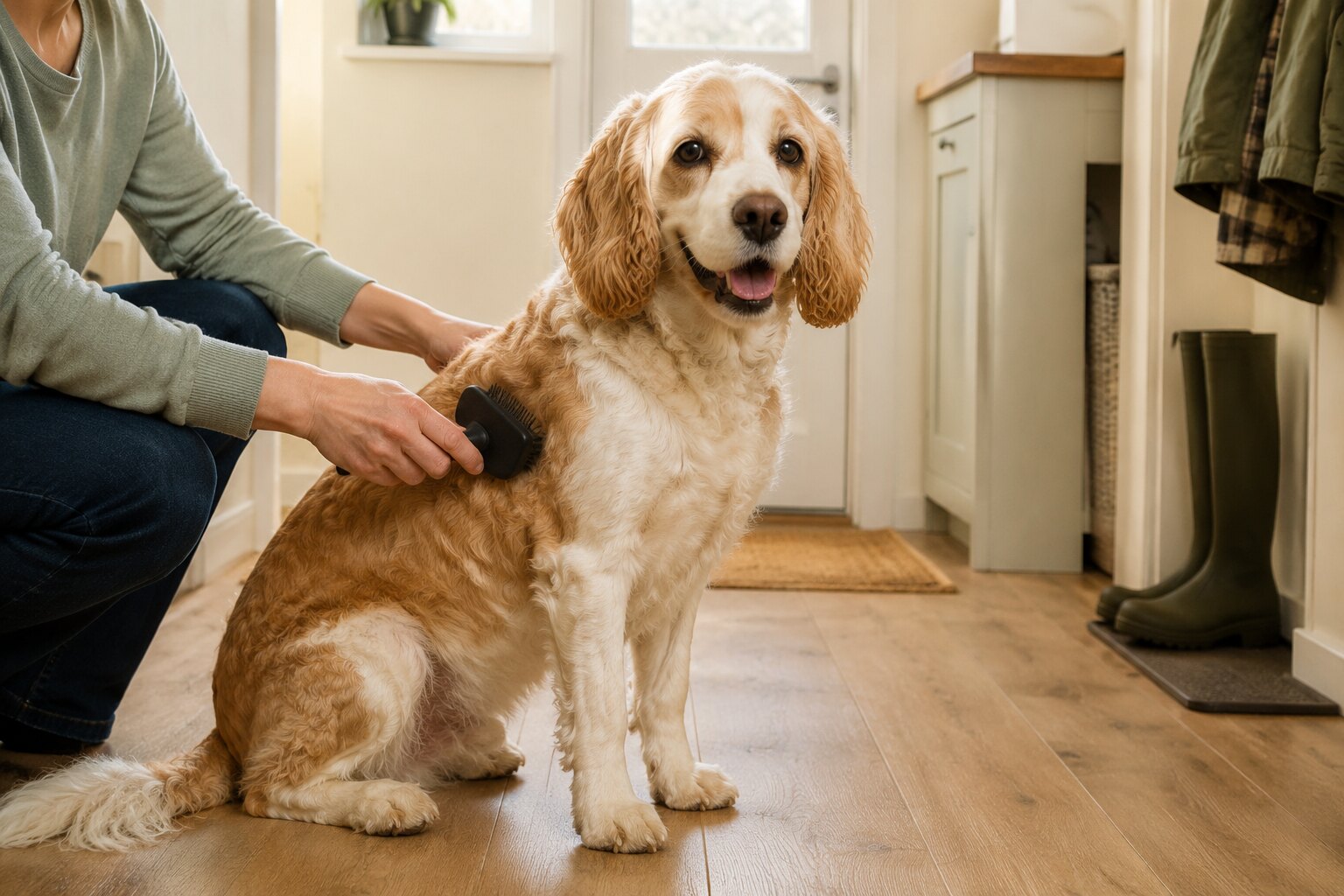
A small tangle can become a stubborn mat surprisingly quickly—especially after rain, swimming, a muddy walk or several days beneath a harness. The good news is that most matting can be prevented with the right tools, a sensible routine and a few minutes spent on the areas owners most often miss.
🐾 Harley hint: Harley’s easiest-to-miss tangles are the friction areas — behind the ears, under the harness and around the legs. A quick comb check after a wet or muddy walk catches them before they tighten. See our Cockapoo brush guide, grooming schedule and muddy-dog clean-up routine.
🐾 Our quick answer
Prevent dog matting by brushing in small sections from near the skin to the ends, then checking your work with a metal comb. Concentrate on friction points such as behind the ears, beneath the collar and harness, the armpits, legs, tummy and tail. Remove loose tangles before bathing, dry the coat thoroughly and book a professional groomer when a knot is tight, painful or close to the skin.
What is a mat in a dog’s coat?
A mat is a dense knot of hair that has tightened together. Loose hair, moisture, dirt and friction all help separate strands to twist into a compact patch. Curly, long, woolly and double coats can be particularly prone, but any dog can develop tangles where hair repeatedly rubs.
Matting is not simply untidy. A tight mat can pull on the skin, trap moisture and make it difficult to see what is happening underneath. Blue Cross describes grooming as important for preventing matted coats, while PDSA’s grooming guidance explains that brushing frequency should reflect the animal’s coat type.
Where do dogs mat most easily?
- Behind and beneath the ears, where soft hair moves and folds
- Under collars and harnesses, particularly after wet walks
- In the armpits, where the legs create constant friction
- Across the chest and tummy, especially on feathered or curly coats
- Around the legs, paws and tail, where mud, seeds and debris collect
- Around the bottom, which needs prompt attention for hygiene
It is easy to brush the back because it is visible and accessible, then unknowingly leave the awkward areas. A thirty-second “friction-point check” after removing the harness is often more useful than an occasional marathon brushing session.
The tools that make mat prevention easier

You do not need a cupboard full of gadgets. For many longer or curlier coats, a practical kit contains a brush suited to the coat, a metal comb for checking, a towel and—if your groomer recommends it—a dog-safe detangling spray.
| Tool | What it does | What to watch |
|---|---|---|
| Slicker brush | Separates longer, curly or dense hair in sections | Use light pressure; pins should not scrape the skin |
| Pin brush | Useful for looser coats and finishing longer hair | May skim over knots in a dense undercoat |
| Metal comb | Checks whether the coat is clear down to the skin | Do not drag it through a tight mat |
| Dog-safe detangler | Adds slip to small, loose tangles | Follow the label and avoid eyes, mouth and sore skin |
A simple grooming kit to compare
- Wahl Pro Slicker Brush — a commercially linked option for owners comparing slicker brushes.
- Wahl Metal Combined Comb — combines wider and narrower teeth for checking different areas.
- Ancol Ergo Pin Brush — an option to compare for finishing and looser sections of coat.
Pet Villa code: use HARLEYBARLEYCO where eligible. These are products to compare; we are not claiming Harley has personally tested each tool.
For a fuller breakdown of which brush suits which texture, see our guide to the best brushes for different Cockapoo coat types. The same brush-and-comb principle is useful for many wavy and curly-coated dogs.
How to brush a dog properly to prevent mats
1. Start with a dry, comfortable dog
2. Divide the coat into small sections
Lift the hair so you can see where it meets the skin. Brush one layer at a time in the direction the coat grows. This “line brushing” approach avoids making the surface look fluffy while tangles remain hidden underneath.
3. Support the hair above a tangle
Hold the hair gently between the knot and the skin to reduce pulling. Work on a small, loose tangle from the ends upwards with short strokes. If it does not loosen easily, do not turn the session into a battle.
4. Finish every section with the comb
The comb is the honest friend in the grooming kit. If it glides from near the skin to the ends without snagging, the section is clear. If it catches, return to the brush rather than forcing the comb through.
5. Keep sessions short and positive
Several calm five-minute sessions are better than one stressful hour. Reward stillness, practise handling away from knots and stop before your dog becomes frustrated. Dogs that dislike grooming may need a gradual handling plan with help from a qualified groomer or reward-based trainer.
Should you brush before or after bathing?
Remove loose tangles before the bath. Water can tighten existing knots, and shampoo cannot clean or rinse the skin properly beneath a dense mat. Blue Cross advises brushing before washing and dealing with matted hair before it becomes harder to remove when wet.
After bathing, dry the coat thoroughly and gently comb it through. Pay particular attention after wet walks or swimming. Our guide to cleaning a muddy dog after a walk includes a practical doorway and drying routine.
⚠️ Do not cut a tight mat with scissors
Dog skin is thin and can be pulled up inside a mat, where it is difficult to see. Cutting close to the knot risks cutting the skin. Tight, widespread or painful matting is a job for a professional groomer or vet, who can choose the safest way to remove it.
When does a mat need professional help?
- The knot sits tightly against the skin
- Your dog flinches, cries, growls or repeatedly moves away
- The skin beneath looks red, damp, sore or broken
- Matting covers a large area or restricts movement
- The mat is around the eyes, ears, genitals or bottom
- You cannot tell where the knot ends and the skin begins
In these cases, prioritise comfort over saving coat length. A shorter reset groom can be kinder than hours of pulling at damaged hair. Ask the groomer to show you the tools and routine that will suit the coat as it grows back.
A realistic anti-matting routine
The perfect schedule depends on coat length, density, activity and weather. PDSA notes that some longer-haired dogs need daily brushing, while medium coats may need attention several times a week. Dogs wearing harnesses, swimming regularly or collecting half the countryside in their feathers may need quick checks more often.
- After each wet or muddy walk: dry thoroughly and check friction points
- Several times a week: section-brush mat-prone areas and comb-check
- Weekly: complete a full body check, including paws, ears and tail
- As advised: keep professional grooming appointments before the coat becomes unmanageable
If you have a Cockapoo or another continuously growing wavy coat, our guide to how often to groom a Cockapoo helps turn this into a manageable calendar.
Frequently asked questions
Can you brush out every mat?
No. Small, loose tangles may brush out gently, but tight mats can be painful and unsafe to tackle at home. A professional may recommend clipping rather than prolonged dematting.
Does conditioner remove dog mats?
A dog-safe conditioner or detangling product may add slip to a minor tangle, but it cannot make a tight mat safe to pull apart. Never use a human product unless your vet specifically advises it.
Why does my dog mat under the harness?
The harness creates repeated friction, and trapped moisture makes tangling easier. Remove it once the walk is over, dry the coat and comb the contact areas around the chest, shoulders and armpits.
Will keeping the coat short prevent matting?
A shorter coat is often easier to maintain, but it still needs checking and brushing. Ask your groomer for a practical length that suits your dog’s coat, lifestyle and the amount of maintenance you can reliably manage.
The simple rule: brush in sections, check with a comb and ask for help before a knot becomes painful. Coat care should leave your dog comfortable—not turn the kitchen into a wrestling ring.
This article contains clearly labelled affiliate links. If you purchase through one, Harley Barley & Co may receive a commission at no extra cost to you. Product links are options to compare, not personal testing claims.