
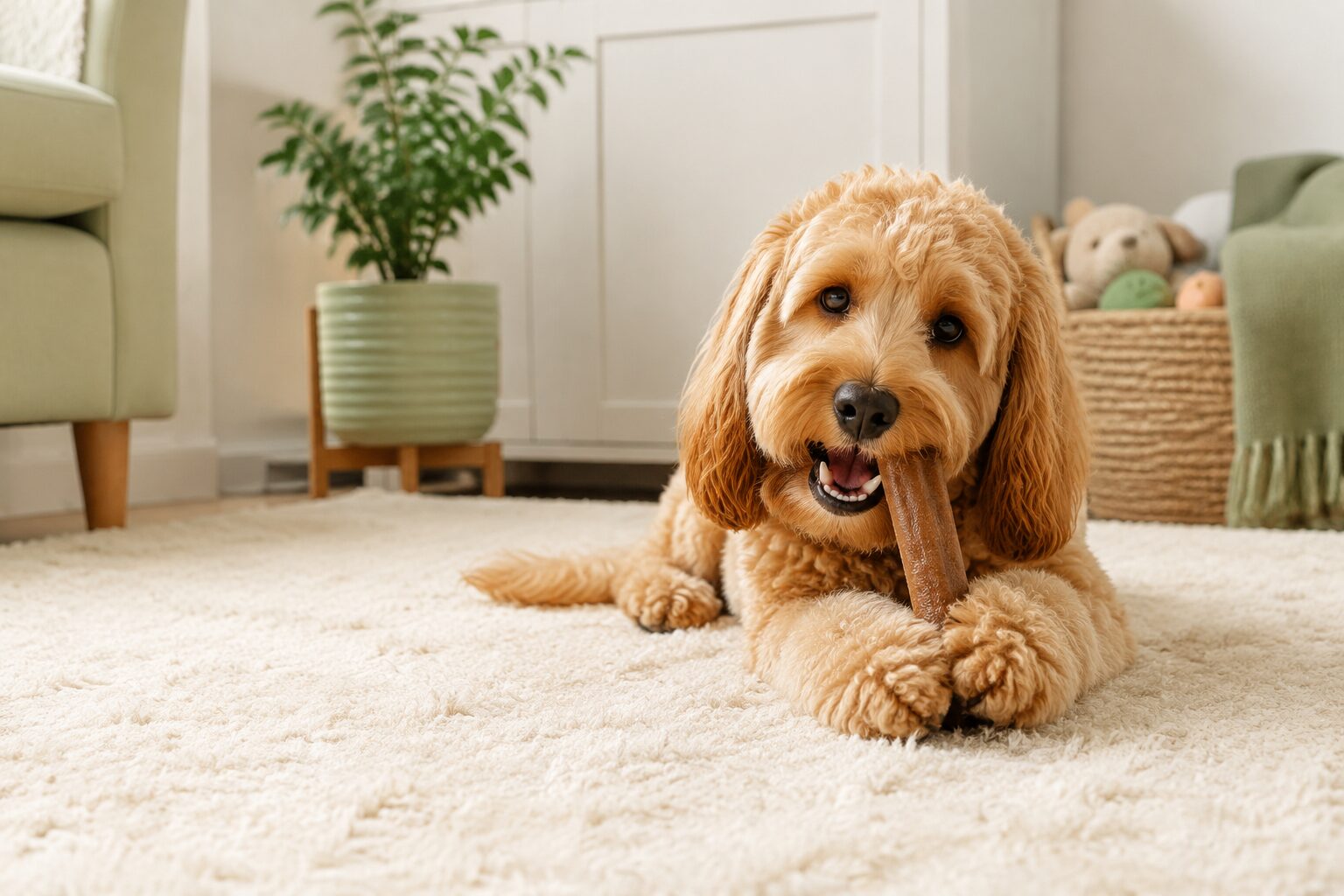
A long-lasting dog chew should occupy your dog without making you nervous every time they bite down. This guide compares reusable, natural and rawhide-free options for UK dogs of every size—including the chews we use or have tried with Harley, our 12kg Cockapoo.
There is no single “best” chew for every dog. A gentle 6kg nibbler, a teething puppy and a 35kg power chewer need completely different products. We will help you match the chew to your dog’s weight, age, teeth, stomach and chewing style, explain what to avoid and show you which options are worth comparing first.
Our best overall pick: a correctly sized KONG
For most dogs, our first choice is a food-stuffable rubber KONG. It is reusable, rawhide-free and easier to adapt than an edible chew: use part of your dog’s normal meal, adjust the filling and freeze it when you need a longer activity. It is especially useful for dogs that try to swallow edible chews too quickly.
Choose by size: small dogs under roughly 10kg need a size they cannot swallow; medium dogs around 10–25kg, including Harley at 12kg, need enough room to lick without getting their jaw caught; large dogs over 25kg and determined chewers may need the tougher version. Always follow the manufacturer’s current weight guide rather than relying on these broad bands.
Check KONG sizes and pricesAffiliate link: we may earn a small commission, at no extra cost to you.
The best long-lasting dog chews UK owners can compare quickly
If you prefer single-ingredient natural long-lasting dog chews, compare the Fidelis range below. We have used Fidelis treats with Harley, but we have not personally stopwatch-tested every product, so we clearly separate our experience from products we are simply suggesting you compare.

Best chew for strong or aggressive chewers
Our first comparison would be the KONG range. Stuff it, freeze it and inspect it before every use. A large dog or power chewer needs a product specifically rated for that chewing strength, while a small powerful dog still needs a size too large to swallow. Replace any rubber toy that is splitting, cracking or shedding pieces.
For an edible alternative, a suitably sized PetVilla Yakers chew may last longer than a softer ear or tripe strip. However, yak-style chews are very firm. If your dog bites down with force rather than scraping and gnawing, ask your vet whether that hardness is sensible for their teeth.
Best natural long-lasting dog chew
Natural does not automatically mean low-fat, easy to digest or suitable for every dog. It usually means the chew is made from a recognisable animal ingredient with minimal processing. Our practical starting points are the Forthglade Natural Dog Chew and the Fidelis range, introduced one at a time so you can see how your dog responds.
Fidelis Pig Ear
Aromatic and satisfying, but not our first choice for dogs needing low-fat treats.
Fidelis Rabbit Ears
Usually a shorter session than a dense yak chew; supervise fur and small ends.
Other options include Fidelis Duck Necks for dogs that enjoy a crunchy texture and Fidelis Beef Tripe for dogs that prefer something softer and smellier. Natural chews vary in shape and density, so inspect the individual piece rather than assuming every item in the bag will behave identically.
Best long-lasting dog chews without rawhide
If you specifically want long-lasting dog chews without rawhide, the clearest alternatives are a reusable rubber toy, an appropriately sized dental chew or a named single-ingredient natural chew. “Rawhide-free” alone is not a safety guarantee: you still need to check hardness, ingredients, size and whether your dog pulls off pieces.
- KONG: reusable and non-edible; our most adaptable option.
- WHIMZEES: an edible dental option, provided the product is suitable for your dog’s age and weight.
- Forthglade Natural Dog Chew: an edible option to compare when you want a recognisable chew rather than rawhide.
- PetVilla Beef chew: a natural beef option; select an appropriate size and introduce gradually.
Best chew for sensitive stomachs
For a sensitive stomach, “boring” is often useful. Start with one ingredient or use a KONG filled with part of the food your dog already tolerates. That avoids introducing several new ingredients at once and makes it easier to identify what caused a reaction.
Offer a small, supervised session first, then wait to see how your dog responds before giving more. Rich ears, fatty chews and large quantities of a new protein may be unsuitable for some dogs. If your dog has recurring diarrhoea, vomiting, diagnosed allergies, pancreatitis or a prescription diet, ask your vet before experimenting with new edible chews.
Best long-lasting chew for puppies
Puppies need products labelled for their age, size and stage of dental development. An adult power-chewer product can be unnecessarily hard, while a tiny chew may become a swallowing risk surprisingly quickly. Choose the puppy version of a reputable rubber toy, keep sessions short and supervise continuously.
A puppy-sized KONG filled with soaked puppy food or part of their normal meal is our most practical starting point. For edible products such as WHIMZEES, check the minimum age and weight on the exact pack—different products within a brand may have different guidance.
Chewing can help redirect a puppy away from furniture, but it does not replace sleep, training or management. Our new-dog shopping list and puppy-biting guide cover the rest of the setup.
Best chews for small, medium and large dogs
Small dogs: broadly under 10kg
Small does not mean weak. Choose a chew that is easy to hold but too large to swallow whole. A small-dog KONG or a dental chew explicitly labelled for your dog’s weight is more predictable than cutting a larger manufactured chew into an arbitrary size. Remove natural ears or strips as soon as the remaining piece becomes gulpable.
Medium dogs: roughly 10–25kg
Harley is around 12kg, so this is the bracket we know best. We favour a correctly sized KONG for a controllable activity, with natural chews used as supervised variety rather than an everyday free-for-all. Medium dogs can still be powerful gulpers, so never choose purely by weight.
Large dogs: broadly over 25kg
Large dogs need a physically larger chew, not simply a harder one. Compare the manufacturer’s large or extra-large options and check that the whole item cannot disappear behind the back teeth. A large Fidelis Beef Ear or correctly sized PetVilla Beef chew may be worth comparing, but a powerful dog that removes chunks needs closer supervision or a non-edible alternative.
Long-lasting dog chews that clean teeth
Chewing can create mechanical rubbing, but no chew replaces toothbrushing or veterinary dental care. WHIMZEES dental chews are a convenient product to compare when dental support is your priority: choose the correct size, follow the feeding frequency on the pack and count the calories within the daily allowance.
Strong smell, bleeding gums, difficulty eating, pawing at the mouth or a cracked tooth need veterinary attention rather than a tougher chew. For the everyday routine, use our easy dog dental-care guide.
Which dog chews should you avoid?
We avoid giving any product a blanket “safe” or “dangerous” label because the dog’s teeth, health and chewing technique matter. These are the situations that make us put a chew back on the shelf or take it away:
- It is small enough to swallow whole or has been chewed down to a gulpable end.
- It splinters, cracks sharply or sheds large chunks.
- It is so hard your dog tries to crack it with full jaw pressure. Antlers, hooves, very hard bones and dense nylon-style items can be a poor match for forceful biters.
- The ingredients are vague. We prefer knowing what the chew is made from.
- It conflicts with a medical diet or is too rich for a dog with digestive problems.
- Your dog guards it. A high-value chew is not worth creating an unsafe situation; work with a qualified behaviour professional.
- It is given unsupervised. “Long-lasting” is not permission to leave a dog alone with it.
Traditional rawhide is not part of our shortlist. If you choose any rawhide product, research its source and processing carefully and discuss suitability with your vet. We prefer the clearer rawhide-free alternatives above.
Chew buying comparison
This table compares formats and practical checks. We have tried Fidelis chews and treats with Harley, our 12kg Cockapoo, but we have not recorded timed results for every product below. Researched options are included alongside that experience; the table is not a ranking based on measured chew times.
| Option | Sizing and use | Texture to consider | Before you buy |
|---|---|---|---|
| KONG | Small, medium and large versions; choose by current pack guide | Flexible rubber | Not edible; filling controls suitability |
| WHIMZEES | Dental option; exact age/weight rules vary by pack | Firm edible chew | Varies by dog; introduce gradually |
| Forthglade Natural Chew | Natural option; check pack size and feeding guide | Firm edible chew | Introduce gradually |
| PetVilla Beef | Natural beef choice; match the individual piece to dog size | Varies by cut | Protein-specific; monitor response |
| PetVilla Yakers | Persistent gnawers with healthy teeth; avoid undersizing | Very hard | Edible, but suitability varies |
| Fidelis Pig Ear | Occasional richer natural chew; size must prevent gulping | Medium | Can be rich/fatty |
| Fidelis Rabbit Ear | Smaller natural chew and texture variety | Light–medium | Introduce fur gradually |
| Fidelis Duck Neck | Crunchy natural option; supervise fragments | Crunchy/firm | Introduce gradually |
| Fidelis Beef Ear | Larger natural option; useful to compare for larger dogs | Medium–firm | Introduce gradually |
| Fidelis Beef Tripe | Dogs preferring a softer, highly aromatic chew | Softer | Rich smell; monitor stomach |
How long will a chew last for your dog?
There is no reliable time guarantee from the product name alone. The size of the piece, your dog’s chewing style and the way a food toy is filled can change a session dramatically. Harder does not automatically mean a better choice.
Choose suitability first. Supervise the whole session and remove a piece before it becomes a swallowing risk; a long-lasting label is not permission to leave the dog alone with it.
How to make a dog chew last longer safely
- Choose the right size: it should not fit wholly inside the mouth or be easy to gulp.
- Freeze suitable food toys: use part of the normal meal rather than automatically adding extra calories.
- Use a holder: a chew holder may help keep certain compatible chews secure, but it does not replace supervision.
- Rotate rather than overload: alternating textures keeps novelty without giving several rich chews in one day.
- Store them properly: follow pack instructions and use an airtight treat container to contain strong smells.
- Remove the final piece: do not wait for a gulpable end to become an emergency.
Frequently asked questions
What dog chews last the longest?
Frozen food-stuffable rubber toys are often the most controllable long-lasting option because you can adjust the filling and preparation. Dense yak-style chews may last longer than ears or tripe for gentle gnawers, but hardness and dental suitability matter more than achieving the longest possible time.
What is the safest chew for a dog?
There is no universally safest chew. Choose one intended for your dog’s age, weight and chewing style, make sure it cannot be swallowed whole, inspect it before use and supervise throughout. For many gulpers, a correctly sized food-stuffable rubber toy is a more manageable starting point than a hard edible chew.
Are yak chews safe for dogs?
Yak chews can suit calm gnawers with healthy teeth, but they are very hard and may not suit dogs that bite down forcefully or have dental problems. Choose the correct size, supervise, remove small ends and follow the exact pack instructions if turning the remainder into a puff.
Are pig ears safe for dogs?
Pig ears can be an occasional supervised chew for some dogs, but they can be rich and relatively fatty. Select one too large to swallow whole, practise good food hygiene and avoid it if your vet has advised a low-fat diet or your dog reacts badly to rich foods.
Are rabbit ears safe for dogs?
Rabbit ears can provide a lighter natural chewing activity when correctly sized and supervised. Introduce them gradually—especially ears with fur—and remove any small remaining piece if your dog is likely to gulp it.
How long should a dog chew for?
There is no required session length; ten to twenty supervised minutes can be plenty, particularly with a new product. Stop earlier if your dog is frantic, biting with force, pulling off large pieces, bleeding from the mouth or trying to swallow the chew.
What are the best long-lasting dog chews for aggressive chewers?
Start with a correctly sized tough rubber toy made for powerful chewers and inspect it frequently. The hardest edible chew is not automatically the best: forceful biters may be at greater risk of damaged teeth or large swallowed pieces.
Which long-lasting dog chews are low fat?
A food toy filled with part of your dog’s usual meal offers the clearest calorie control. Natural does not necessarily mean low-fat, so check the analytical information on the pack and ask your vet for guidance if your dog has pancreatitis, weight-management needs or another medical condition.
Our final recommendation
If you want one adaptable place to start, choose a correctly sized KONG, use part of your dog’s normal food and freeze it for a longer session. For a natural chew, compare Forthglade or the Fidelis range, choosing by the individual dog rather than the boldest claim on the packet.
Ready to choose?
Reusable and adaptable: compare KONG sizes. Natural variety: browse Fidelis chews. Whichever you choose, supervise and remove the final small piece.
Shop the KONG range Browse Fidelis chewsContinue with our best puzzle toys for dogs, learn how much mental stimulation a Cockapoo needs, build an easy dog dental-care routine, or use our new-dog shopping list.
This article contains affiliate links. If you buy through one of them, Harley Barley & Co may receive a small commission at no extra cost to you. We only include products where they genuinely fit the advice. This guide is general information and does not replace advice from your vet.