
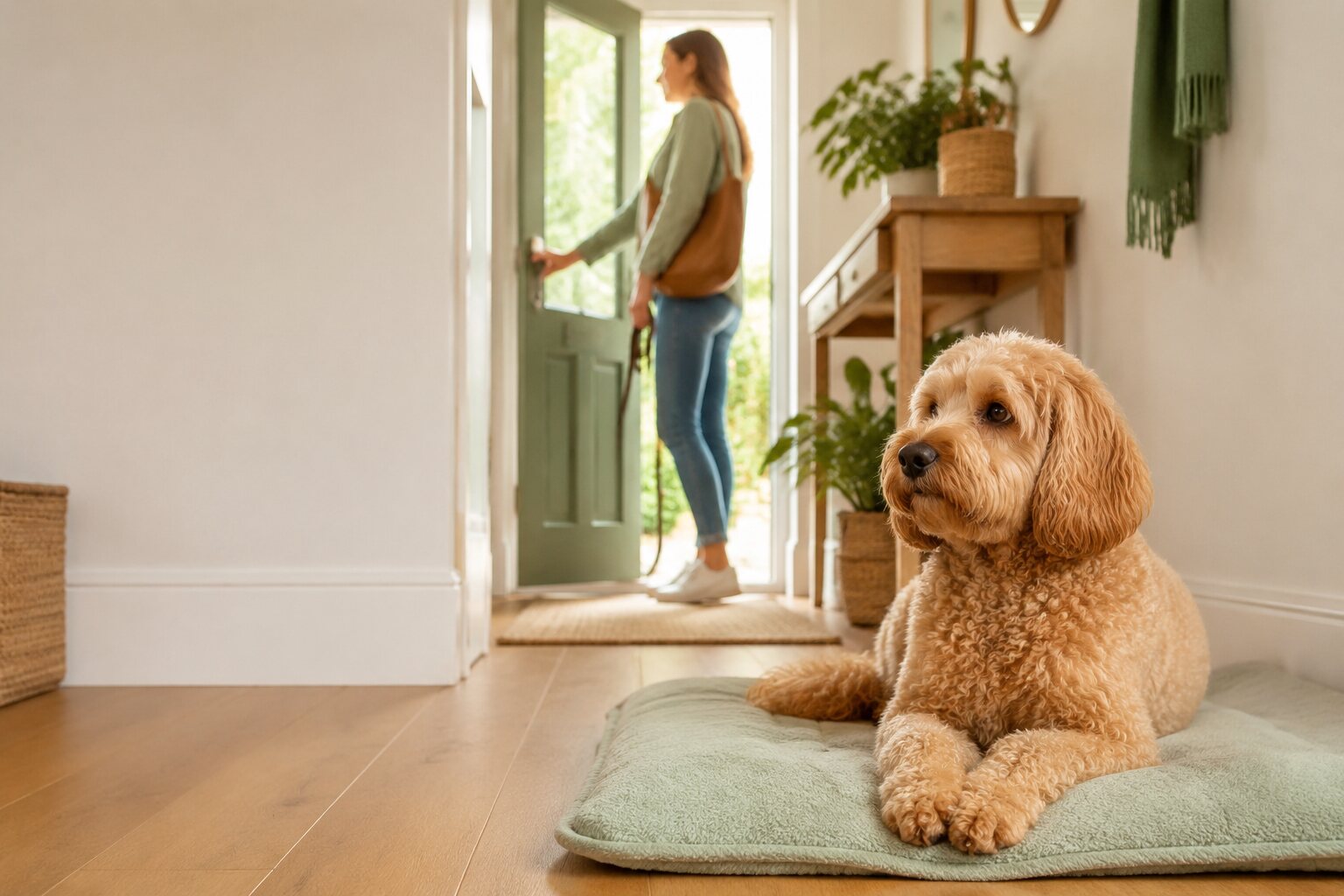
🐾 Harley hint: Start with the smallest version of being alone that your dog can cope with calmly, rather than waiting for them to become distressed. For dogs who need help settling their brain first, our Cockapoo mental-stimulation guide and indoor enrichment ideas are useful alongside gradual alone-time training.
Cockapoos are often sociable, people-focused dogs, but that does not mean every Cockapoo will develop separation anxiety—or that an affectionate dog is automatically “too attached”. The important question is what your dog does after you leave, not how enthusiastically they follow you around while you are home.
What are the signs of separation anxiety in a Cockapoo?
Signs usually begin before departure or shortly afterwards. They can include:
- Barking, whining or howling that continues after you leave
- Pacing between doors and windows
- Scratching doors, chewing frames or trying to escape
- Panting, trembling or excessive drooling
- Toileting indoors despite being reliably house-trained
- Ignoring a chew or food toy they would normally love
- Becoming unsettled when you pick up keys, put on shoes or prepare to leave
Useful reality check: destruction does not always mean anxiety. A bored dog may dismantle a cushion quite cheerfully. A simple camera recording can help you distinguish relaxed mischief from genuine distress.
Why do Cockapoos struggle with being left?
There is rarely one neat cause. A dog may never have learned to be alone gradually, may have experienced a frightening event while left, or may be reacting to a change in routine, a house move, illness, adolescence or a sudden increase in time alone.
Cockapoos can be highly engaged with their families, which may make the difficulty more noticeable, but this is an emotional response, not stubbornness or revenge.
How do I know how long my dog can cope?
Use a camera and start with an absence much shorter than you think is necessary. Watch for subtle changes: stopping the chew, staring at the door, lip-licking, pacing or becoming unable to settle. The useful training duration is the time before those signs begin.
Harley’s-house rule: start with a duration that feels almost comically easy. Success might initially mean closing an internal door for two seconds—not going to the supermarket.
How to help a Cockapoo with separation anxiety
1. Prevent rehearsing full panic where possible
Training is much harder if the dog repeatedly experiences an absence they cannot handle. During the early stages, use family, a trusted sitter, suitable daycare or adjusted routines where practical.
2. Build calm independence while you are home
Reward your dog for resting on their own bed while you move around. Step away, return before they become worried and build distance gradually. This is not about ignoring your dog; it teaches them that space can feel safe.
3. Make departure cues boring
Pick up your keys, then make a cup of tea. Put your coat on, then sit down. Practise only when your dog is calm and avoid repeating cues until they are distressed.
4. Increase alone time below their threshold
Move from an internal door to the front door, then to very short absences. Increase in seconds rather than making large jumps. If your dog shows concern, the next repetition should be easier.
5. Use enrichment as support—not a disguise
A familiar food toy or safe chew may help a dog who is already comfortable. It will not cure panic. If your dog abandons food as you leave, treat that as valuable information and shorten the absence.
Helpful reading for calmer alone time
Begin with our guide to mental stimulation for Cockapoos, then compare puzzle toys for dogs. Enrichment should be introduced while you are present before anything is left with a dog unsupervised.
What should you avoid?
- Do not punish damage or toileting. The dog cannot connect your reaction with something that happened earlier.
- Do not force a panicking dog to remain alone. Repeated distress can make the association stronger.
- Do not jump from seconds to hours. Progress is rarely linear.
- Do not rely on exhausting exercise. Appropriate activity helps wellbeing, but an overtired dog can also struggle to settle.
When should I speak to a vet or behaviourist?
Arrange a veterinary check if the behaviour is sudden, severe or accompanied by physical symptoms. Pain, digestive problems, urinary issues and age-related changes can affect behaviour. Ask your vet about referral to an ABTC-registered practitioner for a tailored plan.
Contact help promptly if your dog is injuring themselves, attempting to escape, vomiting, unable to eat when alone or becoming distressed within seconds of your departure.
Frequently asked questions
Will my Cockapoo grow out of separation anxiety?
Do not rely on age alone. Many dogs improve with careful training and management, but repeatedly practising panic can make the pattern more established.
Should I leave the television or radio on?
Background sound may soften outside noises for some dogs, but it is not a treatment by itself. Introduce it while you are home so it remains familiar.
Should I get another dog?
A second dog is not a reliable treatment. Some dogs are distressed by separation from a particular person even when another animal is present.
Sources and further help
This article contains affiliate links. If you buy through one of them, Harley Barley & Co may receive a small commission at no extra cost to you. We only include products where they genuinely fit the advice.